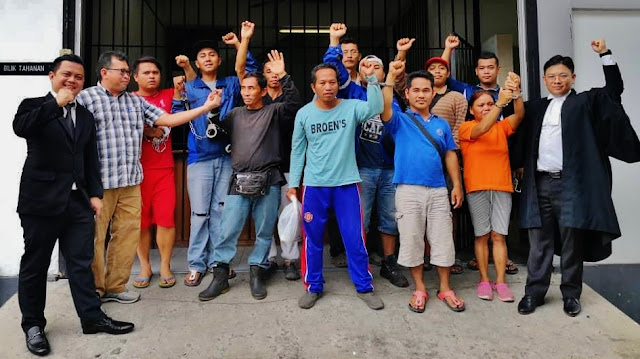
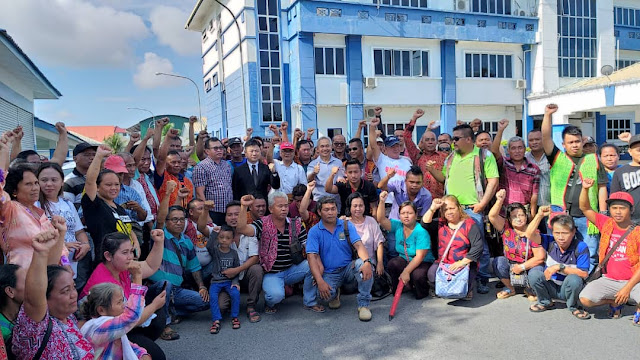
7 December 2012
More pictures can be seen on https://www.facebook.com/media/set/?set=a.544417245587298.146516.376175715744786&type=1
Thursday, 16 May 2013
BREAKING NEWS - Key Australian executive leaves Sarawak dams program - Bruno Manser Fund calls on remaining expats to distance
3 December 2012
Ladies and Gentlemen,
The Bruno Manser Fund has learned from reliable sources that Australian national Andrew Pattle, one of the key staff seconded to Sarawak by Hydro Tasmania under a staff secondment program, has left the Taib government's controversial dams program last month.
Pattle was the senior project manager of the highly controversial Murum dam, which is currently under construction, and until recently described himself as "Senior Project Manager for the proposed Baram and Baleh dams". In April 2012, he participated in a controversial "miring" ceremony held at the Baram dam site to "bless" the proposed dam.
Pattle's personal linked in account says, as of 1st December 2012, that he is now Hydro Tasmania's "Principal Engineer - Civil and Dam Safety di Hydro Tasmania". The linked in entry also says that Pattle was until recently "Senior Technical Manager - Hydro Projects di Sarawak Energy Berhad" and "Senior Project Manager - Baram1 Hydro Electric Project di Sarawak Energy Berhad".
Interestingly, Pattle's Curriculum vitae as presented on linked in directly contradicts a press release issued by hys employer Hydro Tasmania last week. Hydro Tasmania CEO Roy Adair said on 27 November 2012:
“Hydro Tasmania is not involved in flooding rivers and displacing indigenous people. We are not providing consultancy services on the Baram Dam project. A simple check of the facts with us would have established that.”
(Source: http://www.hydro.com.au/about-us/news/2012-11/hydro-tasmania-rejects-national-campaign)
So who is lying, Andrew Pattle or his boss Roy Adair?
The Bruno Manser Fund interprets Mr. Pattle's hasted departure from Sarawak as an indication that Hydro Tasmania's employees are starting to feel the heat from an increasingly successful international campaign against the Sarawak dams program. Last week, Sarawak Chief Minister Taib Mahmud said in an interview that the NGO campaign against his dam program was "economic sabotage". Taib Mahmud is currently under investigation for corruption by the Malaysian Anti Corruption Commission, MACC; many of the dam contractors are closely linked to the Taib family.
The Bruno Manser Fund calls on all expats and consultants working in Sarawak to follow Mr. Pattle's example and dissasociate themselves from Taib's detrimental dams program. Key foreign staff with Sarawak Energy include Norwegian nationals Torstein Dale Sjøtveit and Einar Kilde as well as the Australians Miles Smith, Graeme Maher, James Hannon and Nick Wright.
Your BMF team
Hydro Tasmania in the defensive as Sarawak delegation prepares for Aussie tour showdown
30 November 2012
Ladies and Gentlemen, Dear friends,
After a successful series of events and meetings in Melbourne, Peter Kallang, Chairman of the SAVE Riversnetwork, and James Nyurang Usang, headman from the Baram, are currently preparing for the last leg of their Australia tour in Tasmania.
In Melbourne, Peter and James were hosted at the Parliament House by Greg Barber MP and Sue Pennicuik MP,two Victorian Greens Members of Parliament. They give interviews to local radio stations and met with a number of church and NGO representatives from Uniting Church, Friends of the Earth, the Australian Conservation Foundation and others who are all very sympathetic with the Sarawak indigenous peoples' struggle for their lands, rivers and forests.
Green campaigners in Australia have meanwhile identified a powerful leverage to target Hydro Tasmania by asking Australian consumers to pressure Momentum Energy, a Hydro Tasmania subsidiary, which is selling certified "green" power in Victoria in a highly competitive electricity market. Momentum Energy are currently expanding into New South Wales (and later Queensland) and are very sensitive to brand damage that Hydro's controversial involvement in Sarawak might bring about. http://www.momentumenergy.com.au/about-us
The showdown will take place in Tasmania
On Sunday, Peter and James will meet the former Senator and Australian Greens leader Bob Brown, the champion of the Franklin River, which was saved from being dammed and later declared a UNESCO World Heritage site. On Sunday evening, a public event will be held with Tasmanian Greens MP Kim Booth, who has been following the Sarawak dams campaign with great interest and commitment.
Coming Monday, 3 December, the Sarawak campaigners will meet with Hydro Tasmania CEO, Roy Adair, in Launceston, Tasmania, at 8 a.m. for a one-hour meeting. Adair will be pressured to disclose full information on Hydro Tasmania's involvement in Sarawak and to commit to a staff withdrawal and to severing ties with Sarawak Energy and the Taib government's dam plans.
A press conference is scheduled to be held in Hobart at 1 p.m. on Monday, 3rd December.
On Monday afternoon, the Sarawak delegation will be received by Tasmania's deputy premier, Bryan Green MP, in order to discuss Hydro Tasmania's involvement in Sarawak and the role of the Tasmanian government
On Tuesday, more meetings with Tasmanian politicians will be followed by a public event in Hobart. The tour will conclude with the Tasmanian government being grilled over Hydro Tasmania's activities in Tasmanian parliament on the occasion of Government Business Enterprise (GBE) hearings on Wednesday at noon.
Tour coordinators Adam Burling and Jenny Weber can be reached under info@savesarawakrivers.comor by phone under 0457192507 and 0427 366 929. (Country code Australia: +61)
Hydro Tasmania in the defensive
Interestingly, Hydro Tasmania have started playing down their involvement in the Sarawak dams scheme and clearly appear to be worried about the media fallout of the "Hydro Tasmania - out of Sarawak" campaign. In a media release, Hydro Tasmania said on Wednesday that the company was "not involved in flooding rivers and displacing indigenous peoples" and that they are "not providing consultancy services on the Baram dam project". However, Hydro Tasmania acknowledge that they have "five of our people on secondment" in Sarawak. Source:http://www.hydro.com.au/about-us/news/2012-11/hydro-tasmania-rejects-national-campaign
Research by the Bruno Manser Fund has shown that Hydro Tasmania, along with other Australian companies, are up to their necks in the Sarawak dam plans, in which they play a key role. The following Australian nationals are strongly involved in the Sarawak hydropower plans:
- Andrew Pattle, secondee from Hydro Tasmania, Project Director for the Murum Dam and Senior Project Manager for the proposed Baram and Baleh dams- Miles Smith, Vice President and Head of Planning and Strategy at Sarawak Energy- Graeme Maher, Senior Manager Hydropower Development at Sarawak Energy- James Hannon, Senior Manager Contracts at Sarawak Energy- Nick Wright, the former Senior Advisor to Tasmania's Energy Minister, now holds the position of Vice President with Sarawak Energy
Entura, Hydro Tasmania's subsidiary and consultancy branch, conducted feasibility studies on the proposed Belaga, Pelagus and Metjawah dams. During the investigation, Entura identified another potential dam site, Punan Bah, which is currently undergoing a feasibility study. Entura also advised Sarawak Energy repeatedly on matters concerning the Murum Dam, which is currently under construction
Other Australian companies involved in the Taib government's dams program include SMEC (Snowy Mountains Engineering Corporation) and engineering conglomerate GHD.
The Bruno Manser Fund is calling on the Australian and the Tasmanian governments to terminate Hydro Tasmania's involvement in Sarawak with immediate effect and to inform all Australian nationals and companies involved in the Sarawak dam projects on the human rights and environmental concerns over these projects.
Your BMF team
PS: More than 1200 people have already sent e-mails to Hydro Tasmania CEO Roy Adair. Support Sarawak's indigenous peoples now and sign on under: http://savesarawakrivers.good.do/save-sarawak-rivers/hydro-tasmania-out-of-sarawak
Wednesday, 28 November 2012
Sign the Online Petition to Stop Hydro Tasmania from Damming Sarawak Rivers
+++PLEASE CIRCULATE AND TELL YOUR FRIENDS+++
Ladies and Gentlemen, Dear friends,
As the Save Sarawak Rivers delegation has arrived in Australia, we would like to ask you to sign the new online petition for Hydro Tasmania to stop damming Sarawak rivers. A strong petition will help the Sarawak delegation in Australia
Please access the petition now under:
http://savesarawakrivers.good.do/save-sarawak-rivers/hydro-tasmania-out-of-sarawak
Peter Kallang from SAVE RIVERS and headman James Nyurang Usang have arrived in Sydney and have held some first meetings with media representatives, NGOs and Australian politicans as well as a public event at Bondi Beach. Please find attached two pictures of Peter Kallang and James Nyurang Usang in front of the Sydney Opera House and together with New South Wales MP John Kaye at the state Parliament House today
They will continue their tour on Sunday to Canberra where they will be hosted by Senator Lee Rhiannon (NSW Greens). Lee already hosted Bruno Manser and a Penan delegation during their 1990 world tour. On Monday, they will hold meetings with more opinion leaders in Cannerra, including Australian Labor Party Senator Lisa Maria Singh.
A public event is scheduled for Monday, 26 November, 7 pm at the Canberra Museum and Gallery, 176 London Circuit, Canberra.
Further events will be held in Melbourne, Launceston and Hobart. See: http://www.savesarawakrivers.com
Your BMF team
www.bmf.ch, www.stop-corruption-dams.org
Ladies and Gentlemen, Dear friends,
As the Save Sarawak Rivers delegation has arrived in Australia, we would like to ask you to sign the new online petition for Hydro Tasmania to stop damming Sarawak rivers. A strong petition will help the Sarawak delegation in Australia
Please access the petition now under:
http://savesarawakrivers.good.do/save-sarawak-rivers/hydro-tasmania-out-of-sarawak
Peter Kallang from SAVE RIVERS and headman James Nyurang Usang have arrived in Sydney and have held some first meetings with media representatives, NGOs and Australian politicans as well as a public event at Bondi Beach. Please find attached two pictures of Peter Kallang and James Nyurang Usang in front of the Sydney Opera House and together with New South Wales MP John Kaye at the state Parliament House today
They will continue their tour on Sunday to Canberra where they will be hosted by Senator Lee Rhiannon (NSW Greens). Lee already hosted Bruno Manser and a Penan delegation during their 1990 world tour. On Monday, they will hold meetings with more opinion leaders in Cannerra, including Australian Labor Party Senator Lisa Maria Singh.
A public event is scheduled for Monday, 26 November, 7 pm at the Canberra Museum and Gallery, 176 London Circuit, Canberra.
Further events will be held in Melbourne, Launceston and Hobart. See: http://www.savesarawakrivers.com
Your BMF team
www.bmf.ch, www.stop-corruption-dams.org
23 November 2012
For Immediate Release
The campaign for stopping the involvement of Hydro Tasmania in the Sarawak’s mega dams project was officially launched on the 23rd November 2012 with a meeting at the State Parliament for the state of New South Wales in Sydney Australia.
The meeting was held with Mr. John Kayes, a member of the Australian Green Party and an elected member of the Legislative Council at the Upper House. Representing Save Rivers were Mr. Peter Kallang, the Chairman of Save Rivers and Ketua Kampung Mr. James Nyurang both from Baram, Sarawak. Hydro Tasmania,a company owned by the government of the state of Tasmania. It is providing skilled manpower to Sarawak Energy Berhad under a secondment arrangement with Hydro Tasmania’s subsidiary, Entura.
Among the personnel seconded by Entura to Sarawak Energy Berhad are Mr. Andrew Pattle, who was the project Director for the Murum dam and now the Senior Project Manager for the Baleh and Baram Dam, Mr. Mike Smith a Vice President and Head of Planning and Strategy at Sarawak Energy Berhad, and Mr. Nick Wright a Vice President looking after the Corporate and Social Responsibility at Sarawak Energy Berhad. Mr. Nick Wright was formerly an Advisor to the Minister Energy Minister of the state of Tasmania. In Sarawak Energy Berhad, Mr. Wright responsibility in the dam project involves the resettlement of those affected, the compensation, sustainability and consultation.
Commenting on Save Rivers campaign in Australia, Mr Peter Kallang said that it was necessary as Hydro Tasmania plays a very important role in the building of the 12 dams in Sarawak. Mr. Peter Kallang said, “We want Hydro Tasmania to stop providing their service in building the dams in Sarawak, which is built with total disregard for the wellbeing or consent of the people affected and cause total and irreversible environmental destruction. The government of Australia has to intervene and stop this government owned company in this involvement. We appeal to the Australian public to support our cause. Instead of these mega dams, we would like to request Hydro Tasmania to help the people of Sarawak in setting up alternative source of electrical power in collaboration with the indigenous people and which is environmentally friendly.”
In receiving the representatives from Sarawak, Mr. John Kayes gave his support for the campaign in Australia. From Sydney, Mr. Peter Kallang and Ketua Kampung James Nyurang will travel to Canberra, Hobart, Launceston and Melbourne where they will have meetings with Politicians and Companies in Australia.
- End -
Prepared by:
Peter Kallang
Chairman Save Rivers
Email: peterkallang@yahoo.com

At parlement gardern: Left to Right: James Nurang, John Kaye & Peter Kallang

Welcomed by a representative of the Australian indigenous people: Left to Right: Peter Kallang, Dominic Wy Kanak (Waveley Council Member) & James Nyurang
For Immediate Release
The campaign for stopping the involvement of Hydro Tasmania in the Sarawak’s mega dams project was officially launched on the 23rd November 2012 with a meeting at the State Parliament for the state of New South Wales in Sydney Australia.
The meeting was held with Mr. John Kayes, a member of the Australian Green Party and an elected member of the Legislative Council at the Upper House. Representing Save Rivers were Mr. Peter Kallang, the Chairman of Save Rivers and Ketua Kampung Mr. James Nyurang both from Baram, Sarawak. Hydro Tasmania,a company owned by the government of the state of Tasmania. It is providing skilled manpower to Sarawak Energy Berhad under a secondment arrangement with Hydro Tasmania’s subsidiary, Entura.
Among the personnel seconded by Entura to Sarawak Energy Berhad are Mr. Andrew Pattle, who was the project Director for the Murum dam and now the Senior Project Manager for the Baleh and Baram Dam, Mr. Mike Smith a Vice President and Head of Planning and Strategy at Sarawak Energy Berhad, and Mr. Nick Wright a Vice President looking after the Corporate and Social Responsibility at Sarawak Energy Berhad. Mr. Nick Wright was formerly an Advisor to the Minister Energy Minister of the state of Tasmania. In Sarawak Energy Berhad, Mr. Wright responsibility in the dam project involves the resettlement of those affected, the compensation, sustainability and consultation.
Commenting on Save Rivers campaign in Australia, Mr Peter Kallang said that it was necessary as Hydro Tasmania plays a very important role in the building of the 12 dams in Sarawak. Mr. Peter Kallang said, “We want Hydro Tasmania to stop providing their service in building the dams in Sarawak, which is built with total disregard for the wellbeing or consent of the people affected and cause total and irreversible environmental destruction. The government of Australia has to intervene and stop this government owned company in this involvement. We appeal to the Australian public to support our cause. Instead of these mega dams, we would like to request Hydro Tasmania to help the people of Sarawak in setting up alternative source of electrical power in collaboration with the indigenous people and which is environmentally friendly.”
In receiving the representatives from Sarawak, Mr. John Kayes gave his support for the campaign in Australia. From Sydney, Mr. Peter Kallang and Ketua Kampung James Nyurang will travel to Canberra, Hobart, Launceston and Melbourne where they will have meetings with Politicians and Companies in Australia.
- End -
Prepared by:
Peter Kallang
Chairman Save Rivers
Email: peterkallang@yahoo.com

At parlement gardern: Left to Right: James Nurang, John Kaye & Peter Kallang

Welcomed by a representative of the Australian indigenous people: Left to Right: Peter Kallang, Dominic Wy Kanak (Waveley Council Member) & James Nyurang
Build us roads, not dams, say natives
G Vinod | November 19, 2012
Sarawak-based NGOs want the state government to put a halt to all dam projects.
KUALA LUMPUR: The Baram Dam project will destroy the heritage and livelihood of natives on the pretext of development for Sarawak, said a NGO.
Phillip Jau, chairman of the Baram Protection Action committee, said the state government must put a stop to the construction of the project.
He said this after submitting a memorandum to DAP secretary-general Lim Guan Eng at the old Parliament lobby. Also present were MPs Fuziah Salleh, Charles Santiago and John Fernandez.
“We are not against development but we don’t want this dam. We love our homes and rainforests. Build us roads like the ones in KL and we can bring progress to ourselves,” he said.
The Baram Dam, which is still in the planning stages, is set to flood an area of 412 square kilometres, affecting the lives of more than 20,000 people living in that area.
Among the tribes that would be most affected are the Kenyah, Kayan and the Penans.
Natives’ consent not sought
Save Sarawak Rivers chairman Peter Kallang urged the government to scrap all 12 dam projects mooted under the Sarawak Corridor of Renewable Energy (Score) programme.
He also said that the Baram and the Murum dam projects were proven to have violated international standards on the treatment to indigenious people.
“And Malaysia is a signatory to the United Nations Declaration on the Rights of Indigenous Peoples (UNDRIP).
“The Penans and the Kenyah people had clearly stated that their consent was not sought by the authorities prior to approving the dam project,” said Kallang.
He also said that the Sarawak state government had not even informed the communities on their resettlement plan if the Baram dam is constructed.
“So we demand the government to resolve all this outstanding issue. The government must also abide by the people’s decision should they oppose the dam project,” said Kallang.
Meanwhile, Lim said that Pakatan Rakyat MPs were in support of the natives’ demands as the project is affecting the latter’s livelihood and heritage.
“It’s obvious the project is to profit a select few, not the people of Sarawak as a whole,” he said.
Sarawak-based NGOs want the state government to put a halt to all dam projects.

KUALA LUMPUR: The Baram Dam project will destroy the heritage and livelihood of natives on the pretext of development for Sarawak, said a NGO.Phillip Jau, chairman of the Baram Protection Action committee, said the state government must put a stop to the construction of the project.
He said this after submitting a memorandum to DAP secretary-general Lim Guan Eng at the old Parliament lobby. Also present were MPs Fuziah Salleh, Charles Santiago and John Fernandez.
“We are not against development but we don’t want this dam. We love our homes and rainforests. Build us roads like the ones in KL and we can bring progress to ourselves,” he said.
The Baram Dam, which is still in the planning stages, is set to flood an area of 412 square kilometres, affecting the lives of more than 20,000 people living in that area.
Among the tribes that would be most affected are the Kenyah, Kayan and the Penans.
Natives’ consent not sought
Save Sarawak Rivers chairman Peter Kallang urged the government to scrap all 12 dam projects mooted under the Sarawak Corridor of Renewable Energy (Score) programme.
He also said that the Baram and the Murum dam projects were proven to have violated international standards on the treatment to indigenious people.
“And Malaysia is a signatory to the United Nations Declaration on the Rights of Indigenous Peoples (UNDRIP).
“The Penans and the Kenyah people had clearly stated that their consent was not sought by the authorities prior to approving the dam project,” said Kallang.
He also said that the Sarawak state government had not even informed the communities on their resettlement plan if the Baram dam is constructed.
“So we demand the government to resolve all this outstanding issue. The government must also abide by the people’s decision should they oppose the dam project,” said Kallang.
Meanwhile, Lim said that Pakatan Rakyat MPs were in support of the natives’ demands as the project is affecting the latter’s livelihood and heritage.
“It’s obvious the project is to profit a select few, not the people of Sarawak as a whole,” he said.
No safe water, food for displaced Bakun natives
Joseph Tawie | November 22, 2012
For the displaced natives in Bakun, Sarawak, its a case of 'water, water everywhere, nary a drop to drink'.
KUCHING: All sorts of woes are bedevilling the people living on their “jelatong” houses which are floating on the Bakun dam lake. Their woes range from a foul smell emanating from rotting organic matter submerged at the bottom of the dam to the river’s declining biodiversity and lack of safe drinking water.
The foul rotten egg-like smell is indicative of the presence of hydrogen sulfide and reports of high turbidity and low pH levels are killing off fish life in the dam and tributaries.
Highlighting these woes during his budget speech, Ba’Kelalan assemblyman, Baru Bian, said that he made a four-day trip to Bakun recently to see for himself how the people have fared since their displacement to make way for the dam.
“I was dismayed at the shocking sights that greeted me and the sorry stories told to me by the people living on their ‘jelatong’ houses now floating on the lake.
“The water on which their homes float is foul-smelling due to the rotting organic matter submerged at the bottom of the dam. Downstream from the dam, the river’s biodiversity has degenerated, fish catches have fallen, and once-clean waters smell foul and are unsafe to drink.
“In a paper entitled ‘Physio-chemical Characteristics in the Filling Phase of Bakun Hydroelectric Reservoir, Sarawak, Malaysia’ published in the International Journal of Applied Science and Technology this year, the authors confirmed that the strong rotten egg smell in the water indicated the presence of hydrogen sulfide.
“They also report high turbidity and low pH levels, which are detrimental to fish life in the dam and tributaries. The fall in the fish numbers affects the people negatively, as fish is one of the sources of food that is still free,” said Bian, who is also the Sarawak PKR chairman.
He added that as a result, the villagers are also now without clean water supply even though they are living on a huge expanse of water.
“There are signs warning them against drinking or swimming in the water because of the risk of Melioidosis and Leptospirosis. Water is life and water was once freely available to them from the previously clean rivers, even if they had no piped water.
“Now it is a case of ‘water, water everywhere but nary a drop to drink,” said Bian.
Compensations in dispute
He also pointed out that there were no public toilets in the bazaar at Sungai Asap and locals were forced to go to the bushes to ease themselves.
“Also, the promised compensations of replacement housing, jobs, compensation payments, three acres of land per family, etc have hardly materialised or still in dispute.
“Their experiences are not dissimilar to those of earlier resettlement schemes such as those at Batang Ai. This is a clear reflection of the government’s attitude towards the poorest of the poor of the land – a ‘tidak apa’ and ‘what they never had, they won’t miss’ attitude,” Bian said.
He said given these problems and the recent blockade of the Murum dam by the Penans to highlight their complaints of the government’s violation of UNDRIP and the Equator Principles, it not unreasonable to draw the conclusion that the state government was not fair, transparent and accountable to the affected indigenous communities.
“And yet we call it development to achieve a high-income economy – at the expense of the true ‘Bumiputeras’ of this land.
“The proposed Baram dam will displace more than 20,000 people from their ancestral lands and submerge 26 villagers. The least the government can do is to learn from the mistakes from the other dams and listen to the people for a change.
“Accusing the opposition and NGOs of incitement is not a solution to problems that are real. Telling the Penans to accept change to be progressive is arrogantly brushing aside their fears without listening to their concerns,” he said.
KUCHING: All sorts of woes are bedevilling the people living on their “jelatong” houses which are floating on the Bakun dam lake. Their woes range from a foul smell emanating from rotting organic matter submerged at the bottom of the dam to the river’s declining biodiversity and lack of safe drinking water.
The foul rotten egg-like smell is indicative of the presence of hydrogen sulfide and reports of high turbidity and low pH levels are killing off fish life in the dam and tributaries.
Highlighting these woes during his budget speech, Ba’Kelalan assemblyman, Baru Bian, said that he made a four-day trip to Bakun recently to see for himself how the people have fared since their displacement to make way for the dam.
“I was dismayed at the shocking sights that greeted me and the sorry stories told to me by the people living on their ‘jelatong’ houses now floating on the lake.
“The water on which their homes float is foul-smelling due to the rotting organic matter submerged at the bottom of the dam. Downstream from the dam, the river’s biodiversity has degenerated, fish catches have fallen, and once-clean waters smell foul and are unsafe to drink.
“In a paper entitled ‘Physio-chemical Characteristics in the Filling Phase of Bakun Hydroelectric Reservoir, Sarawak, Malaysia’ published in the International Journal of Applied Science and Technology this year, the authors confirmed that the strong rotten egg smell in the water indicated the presence of hydrogen sulfide.
“They also report high turbidity and low pH levels, which are detrimental to fish life in the dam and tributaries. The fall in the fish numbers affects the people negatively, as fish is one of the sources of food that is still free,” said Bian, who is also the Sarawak PKR chairman.
He added that as a result, the villagers are also now without clean water supply even though they are living on a huge expanse of water.
“There are signs warning them against drinking or swimming in the water because of the risk of Melioidosis and Leptospirosis. Water is life and water was once freely available to them from the previously clean rivers, even if they had no piped water.
“Now it is a case of ‘water, water everywhere but nary a drop to drink,” said Bian.
Compensations in dispute
He also pointed out that there were no public toilets in the bazaar at Sungai Asap and locals were forced to go to the bushes to ease themselves.
“Also, the promised compensations of replacement housing, jobs, compensation payments, three acres of land per family, etc have hardly materialised or still in dispute.
“Their experiences are not dissimilar to those of earlier resettlement schemes such as those at Batang Ai. This is a clear reflection of the government’s attitude towards the poorest of the poor of the land – a ‘tidak apa’ and ‘what they never had, they won’t miss’ attitude,” Bian said.
He said given these problems and the recent blockade of the Murum dam by the Penans to highlight their complaints of the government’s violation of UNDRIP and the Equator Principles, it not unreasonable to draw the conclusion that the state government was not fair, transparent and accountable to the affected indigenous communities.
“And yet we call it development to achieve a high-income economy – at the expense of the true ‘Bumiputeras’ of this land.
“The proposed Baram dam will displace more than 20,000 people from their ancestral lands and submerge 26 villagers. The least the government can do is to learn from the mistakes from the other dams and listen to the people for a change.
“Accusing the opposition and NGOs of incitement is not a solution to problems that are real. Telling the Penans to accept change to be progressive is arrogantly brushing aside their fears without listening to their concerns,” he said.
Subscribe to:
Posts (Atom)